


 Cart
Cart
 sales@molnova.com



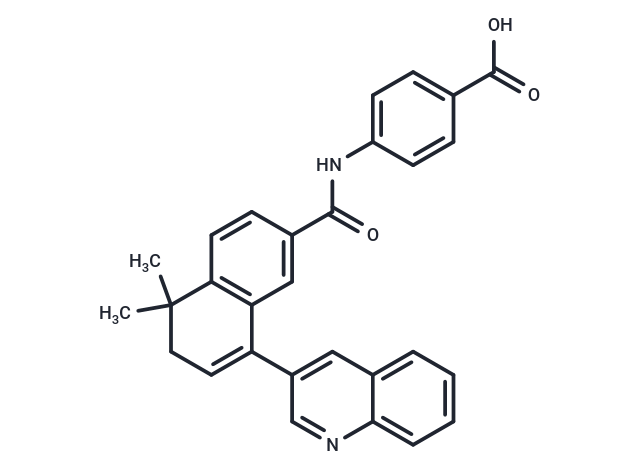
BMS 195614
CAS No. 253310-42-8
BMS 195614( —— )
Catalog No. M33791 CAS No. 253310-42-8
BMS 195614 (BMS614) is a selective RARα antagonist. BMS 195614 can bind to the RARα subunit.
Purity : >98% (HPLC)
 COA
Datasheet
HNMR
HPLC
MSDS
Handing Instructions
COA
Datasheet
HNMR
HPLC
MSDS
Handing Instructions
| Size | Price / USD | Stock | Quantity |
| 2MG | 275 | Get Quote |


|
| 5MG | 397 | Get Quote |
|
| 10MG | 588 | Get Quote |
|
| 25MG | 909 | Get Quote |
|
| 50MG | 1224 | Get Quote |
|
| 100MG | 1602 | Get Quote |
|
| 500MG | 3222 | Get Quote |
|
| 1G | Get Quote | Get Quote |
|
Biological Information
-
Product NameBMS 195614
-
NoteResearch use only, not for human use.
-
Brief DescriptionBMS 195614 (BMS614) is a selective RARα antagonist. BMS 195614 can bind to the RARα subunit.
-
DescriptionBMS 195614 (BMS614) is a selective RARα antagonist. BMS 195614 can bind to the RARα subunit.
-
In Vitro——
-
In Vivo——
-
Synonyms——
-
PathwayMetabolic Enzyme/Protease
-
TargetRetinoid Receptor
-
RecptorRetinoid Receptor
-
Research Area——
-
Indication——
Chemical Information
-
CAS Number253310-42-8
-
Formula Weight448.51
-
Molecular FormulaC29H24N2O3
-
Purity>98% (HPLC)
-
Solubility——
-
SMILESCC1(CC=C(C2=C1C=CC(=C2)C(=O)NC3=CC=C(C=C3)C(=O)O)C4=CC5=CC=CC=C5N=C4)C
-
Chemical Name——
Shipping & Storage Information
-
Storage(-20℃)
-
ShippingWith Ice Pack
-
Stability≥ 2 years
Reference
molnova catalog



related products
-
BMS641
BMS641 (BMS-209641) is a selective and potent RARβ agonist with high affinity for RARβ, which synergistically activates RARβ and RARgamma to induce cellular maturation into specialized neuronal subtypes.
-
LG-100064
LG-100064 is an agonist of retinoid-X-receptor (RXR)(EC50s of 330 nM, 200 nM, and 260 nM for RXRα, RXRβ and RXRγ)LG-100064 shows no effect on RARα/β/γ (EC50, >10000 nM).LG-100064 (3-Methyl-TTNCB) is a retinoid-X-receptor (RXR) agonist, with EC50s of 330 nM, 200 nM, and 260 nM for RXRα, RXRβ and RXRγ.
-
Ch55
Ch55 is an effective inducer of the differentiation of HL60 cells (EC50 = 200 nM) and shows high affinity with RAR-α and RAR-β receptors.
